Sunday, August 30, 2015

Travel Posts Featured in Online Publications - August 2015

To share my travel stories and try to attract new blog subscribers, occasionally I repost my blog entries on Twitter (Twitter handle @KimberlyLeupo). Over the last month, four of my articles have gotten "picked up" and shared globally through online publications.

I wanted to share the online publications and link to the blog posts just in case you missed them. Thank you all for your support. If you have feedback on any of my blog posts, have an idea for a story or would like to be a guest blogger, feel free to email me at KimberlyLLeupo@hotmail.com.


Havana, Cuba: A Romance with the Past
featured in "Travel Cuba @TravelNewsCorp."


Reykjavik, Iceland: Northern Lights & Glaciers featured in "The Arctic Monitor."


Fancy a Visit to Fennoscandia?
featured in "The Arctic Monitor."


Hostel Nightmares: How to Avoid Sleeping
with the Maid
 featured in "Hostel Today."


Saturday, August 29, 2015

Drinking Your Way Around the World


Athens, Greece: Digging into an Ancient City - August 2015


After Greek island hopping, and before venturing to the countryside to visit the ancient cities of Corinth and Mycenae, my husband, James, and I had one day to take in historic Athens.

Based at the Hotel Central in the Plaka neighborhood, we made the most of our time exploring all of the must-see attractions:

The Acropolis. Perched on a hill overlooking the city, the Acropolis of Athens is dedicated to the goddess Athena. First constructed in the 6th century BC the area contains the ruins of the Parthenon, the Propylaia, the temple of Athena Nike, the Erechtheion, and provides breath-taking views of the modern city. Get there early to avoid the crowds and beat the afternoon heat. Also of note, your 12 Euro ticket is good for entry into several other ruins throughout the city.

Temple of Olympian Zeus. Taking more than 700 years to build, this temple is revered as one of the most significant in Athens. Unfortunately, only 15 of the 104 Corinthian-style marble columns still stand.

The Ancient Greek Agora. Long before the word agora became associated with a Greek marketplace, it was the site for orators to engage the public. The ancient Athens agora was the stage for the likes of Plato, Aristotle and Socrates while being the heart of the city. Today you can walk the line of moments paying homage to each of the twelve mythological Greek gods on the way to visit the Temple of Hephaestus. Also of note the Roman agora is minutes away and, while smaller, is home to Hadrian's Library.

Our next stop was the Panathenaic Stadium. One of the most well-known sites in the country, the current stadium was built upon the grounds of an ancient Greek stadium which from 329 BC hosted games for centuries. The current stadium, constructed in 1894, is responsible for reviving the games and hosting the first International Olympic Games two years later. Fun fact: the term marathon, which also happens to be an Olympic sport, stems back to city of Marathon, Greece. Precisely 26.2 miles from Athens, it's where sandal-clad solider Phiddipides began the run to Athens to announce the victory of the Greek Army over the 50,000 Persian invaders in 490 BC.

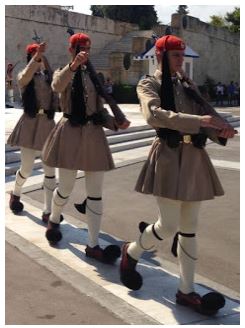
For lunch we feasted on gyros and moussaka before walking busy Ermou Street to peek into shops selling leather sandals, Christian Orthodox relics and mink coats. We photographed the 11th century church of Panagia Kapnikarea, near Syntagma Square, and while in the neighborhood visited the Hellenic Parliament. There, every hour the soldiers of the Presidential Guard march in traditional uniform which includes funny-looking shoes with large wool pompons on the tip called tsarouhia.
 
The National Archaeological Museum. Our final stop was the largest museum in Greece which houses ancient Greek Art and where you can follow Greek history from the 6th century BC through the fall of the Roman Empire.
 
For dinner we enjoyed traditional Greek cuisine at The Old Tavern of Psaras in Plaka dining on eggplant, octopus and mussels washed down with anise-flavored ouzo. At the restaurant our animated waiter informed us that Greece is the origin of everything novel in the world and that the only word in the Greek language which isn't Greek is its name.
If you can weather the heat and mosquitoes, August is an ideal month to visit the city as the locals flock to the countryside and islands for holiday. We would not have been able to see as much of the city as we did without enlisting the help of our friendly driver, Kostas, from George's Taxi. Another handy tip is to download the free app: Athens by GreekGuide.com for accommodation and food recommendations as well as helpful information on getting around, attractions and history.

Santorini, Greece: The Good, The Bad & The Ugly - August 2015


The Good:
  • Scenery. The island of Santorini is a photographer's dream. White walled buildings and blue domed churches clutch to rock cliffs surrounding seas of the brightest blue. Winding cobblestone alley ways and terraces overlook black, white and red beaches. The views are incredible and the sunsets glowing. Santorini's two islands sit at the edge of a massive sea-filled cauldron formed by a volcanic eruption circa 1500 BC.
  • Public Transport. Surprisingly, no matter your budget or preference, the public bus is your ride of choice. It conveniently navigates all the major towns on the island with several pick-ups each hour. It is clean and costs only a couple Euros each way.
  • Food. While pricey, there is no shortage of dining options on the island. Nearly every hotel or bed and breakfast has a restaurant. The seafood selection is vast and some places appeal to customers by hanging fresh daily catches in the windows. Gyros and souvlaki vendors are everywhere, but it's wise to grab a bite on the side streets or in an eatery without a view to enjoy for a fraction of the price.
  • Shopping. Countless shops line the walkways of each of the main towns on Santorini. You can find everything from high-end jewelry and fashion, to locally-made handicrafts and artwork. As with elsewhere in Greece, be sure to haggle and scout out the competition before your buy.

The Bad:
  • Hoards of Tourists. Santorini is a tourist island. Every year more than 500,000 tourists flock to the 37 square mile island with many ascending in mass from cruise ships; it's not uncommon to find a handful of cruise liners docked at the old port of Fira each day. The narrow streets become elbow-to-elbow and lines for popular attractions wind around blocks.
  • Getting Around. Because the towns on Santorini are located up and around volcanic cliffs, getting around should be a key consideration. To access our hotel room from the reception, we descended five stories by elevator and then an additional eight flights of stairs by foot. Walking from town to town looks doable on the map but considering most of the journey is uphill and through narrow corridors, this may be an overly ambitious activity. Regardless of how you plan to get around, be sure to bring good walking shoes; water footwear is also recommended if you plan to explore the hot springs or seas around the volcano.
  • Transportation Options. Aside from the public bus, cars, ATV's and scooters are available for rent. The cost is minimal but beware: parking is limited on the island, drivers can be certifiable and, depending on your rental agreement, any mishap can result in your paying the full price of the vehicle.
  • The Heat. While the mercury doesn't rise to record-breaking heights, the heat on the island can be suffocating. Steep stairs, scarce shade and masses of people only compound the feeling in the summer months. On any excursion, be sure to bring plenty of bottled water as the tap water is unsuitable for drinking.
  • Late Bookings. Summer is peak tourism season and many hotels book up months in advance. Waiting until the last minute can lead to paying exorbitant amounts or getting stuck with less than desirable accommodation.

The Ugly:
  • Taxi Shortage. With tens of thousands of tourists meandering through Santorini's towns, it's surprising that only 36 taxi cabs work the island. Because of the demand, it is a good idea to arrange airport pick-up and return with your lodging well in advance. Pre-arranged tours and excursions are also a good idea, as well as taking advantage of boat transportation when attempting to span the islands.
  • Route to Fira Port. The Old Port of Fira is where many boat excursions depart. The easiest path down the volcanic cliff is by way of the cable car, however if a cruise ship is in port, this may not be an option due to the massive lines. In this case, you are forced to trek down the steep mountain by a 600+ step path paved in animal excrement and traveled by herds of donkeys and their angry handlers. Rumor has it that the donkey handlers purposefully push and scare tourists to deter walking the trail. The slippery and smelly hike down the hill is not for the faint of heart.
  • Toilet Paper Robbery. According to the locals, a woman whose sanity is questionable robs all of the toilet paper from the restrooms of Oia's main square every morning. She then sits at the entrance to the restroom charging a fee for the paper and shouting obscenities at the passersby. Tourists are advised to bring their own tissues to town and ignore the crazy woman.